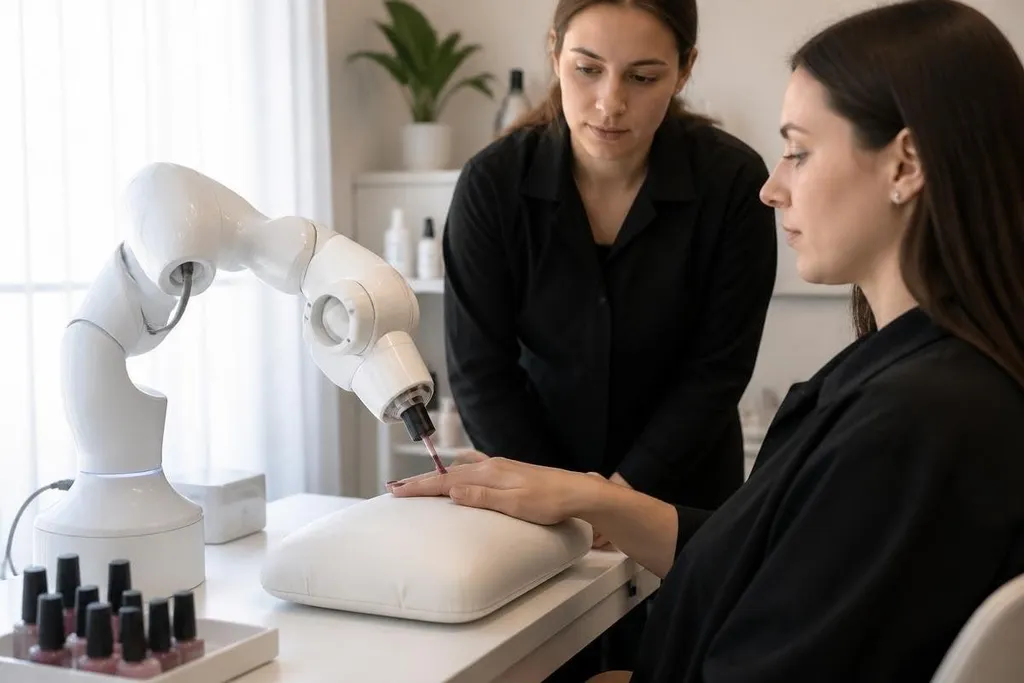
A robot that paints a nail or guides a styling tool works within millimetres of skin, eyes, and hair. That makes beauty care a harder robotics task than the polished demo may suggest.
For a salon owner or product buyer, the useful question is simple: can the robot repeat a small task safely, with a person close by, and without turning setup into a second job?
- Skin contact demands force sensing, not only cameras.
- A salon needs fast cleaning and tool changes between clients.
- Any product claim needs proof from repeated tasks, not one edited clip.
Where the robot has to work
Beauty work has a narrow operating space. A hand, face, or scalp can move without warning, while the tool may carry a blade, heat, liquid, or sharp edge. A robot arm must track the person and react when contact changes.
That calls for more than image recognition. A depth camera can measure distance, while force sensors can detect pressure at the tool. The control system then needs a safe stop when the person moves or the measured force rises.
Nail painting is a clear test case because the work area is small and the result is easy to inspect. Hair styling is harder: hair bends, tangles, and changes shape as the tool moves. Makeup brings another problem, since a small position error can place a tool near an eye.
A useful system will keep the person in control. The customer should be able to stop the motion without asking a staff member to find a hidden button.
The software is only one part
A beauty robot also needs a repeatable work process. That includes identifying the person’s position, choosing the right tool, checking the tool before contact, and cleaning the parts that touch skin.
The end effector, meaning the tool fixed to the robot arm, may need to change between jobs. A polish brush, hair dryer, and makeup applicator cannot share the same cleaning process. The salon still needs clear rules for storage, disposal, and inspection.
The salon’s tool rules give you a useful test for reports on beauty robots, including Robot24.com robotics coverage. Check whether each report names the tool, operator, and stop method, then look at how the worker controls the service.
The user interface matters as much as the arm. A worker may need to set the service, confirm the person’s position, adjust pressure, and stop the task. Those steps should be visible on a screen or control panel rather than buried in a technical menu.
What remains unproven
The hardest proof is repeatability across real people. Skin tone, nail shape, hair texture, head movement, and preferred service can all change the task. A system that works on one model may need new settings for the next customer.
Cleaning is another open issue. A robot can repeat a motion, but that does not show that its brush, grip, or contact surface is safe for the next person. Buyers need written cleaning steps, approved materials, and a clear record of which parts must be replaced.
Speed also needs a fair test. A robot that takes longer than a trained worker may still help with a narrow service, but the price must match that limit. A short demo cannot show staffing needs, failed attempts, setup time, or recovery after a person moves.
I'd skip any beauty robot whose maker shows a finished result but gives no force limit, stop method, cleaning plan, or failure data.
A buyer's safety check
Before a salon signs a purchase order, check these points with the maker:
- Contact control: Ask how the system measures pressure and what happens after a sudden movement.
- Manual stop: Find the emergency stop and test whether a customer or worker can reach it.
- Tool hygiene: Get the cleaning steps, replacement schedule, and list of parts that touch skin.
- Task limits: Ask which nail, hair, or makeup services the robot can perform without hand guidance.
- Service records: Request results from repeated jobs, including failed attempts and recovery time.
- Staff work: Count setup, calibration, tool changes, and cleaning in the time per customer.
The next test for beauty robots
The category will earn trust through narrow services with clear limits. A robot that handles one small job safely, records its failures, and lets a worker take over has a usable starting point.
The next useful evidence is not a smoother video. It is a dated test log showing repeated services, stop events, cleaning time, and the number of jobs completed without manual correction.